Mixed reality can support multi-robot supervision by presenting robot state, maps, sensing, and commands
in the operator's workspace. Existing systems are often tied to specific robots, missions, or visualization
pipelines. HORUS addresses this by using a registration-driven architecture in which robots declare their
frames, sensors, maps, task interfaces, models, and teleoperation channels, and the MR runtime constructs
the corresponding operator workspace.
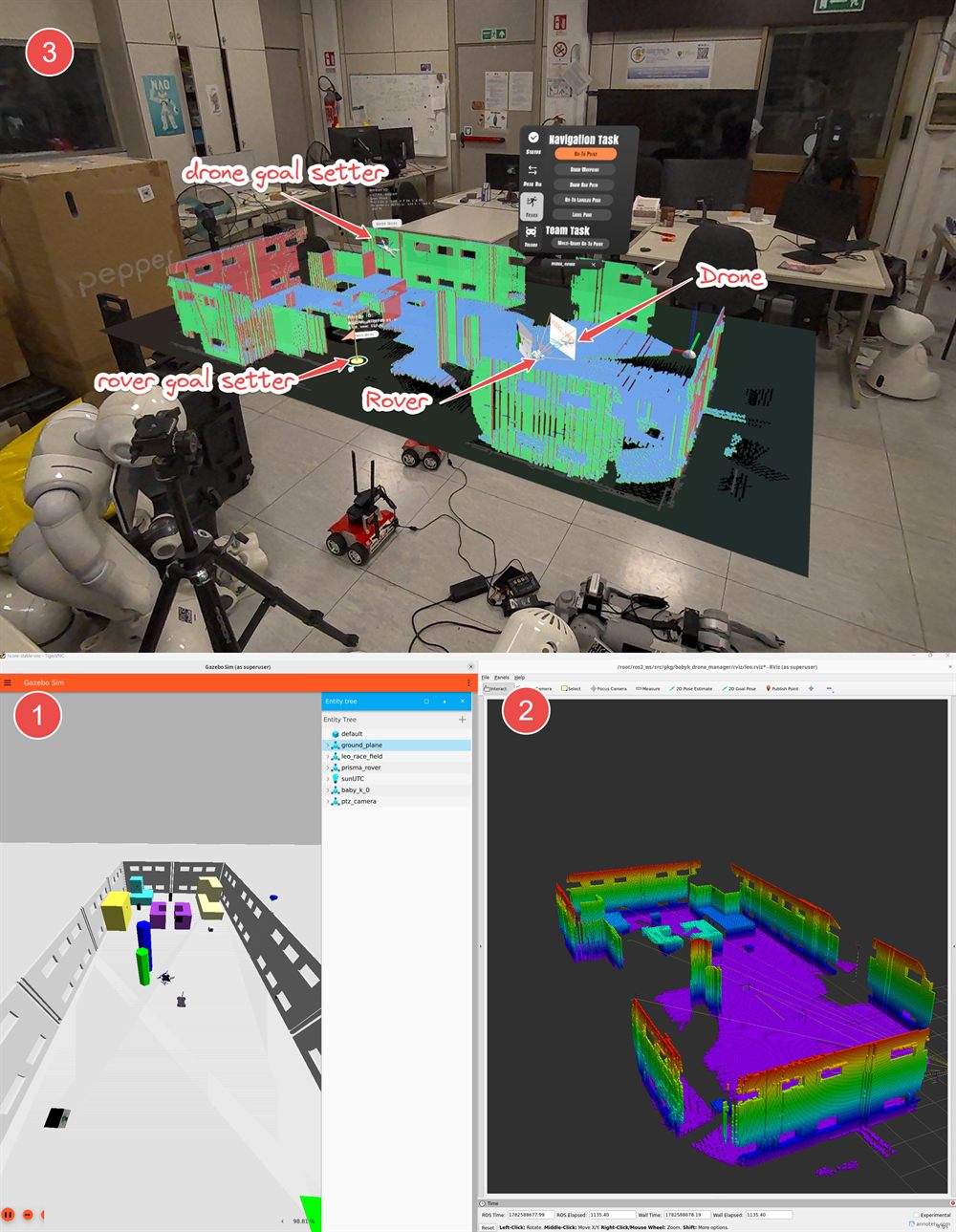
The paper describes the HORUS stack, including the MR runtime, Python SDK, and ROS 2 bridge; shared and
private multi-operator workspaces; and bridge-enforced per-robot control leases. It also characterizes
latency, camera streams, map representations, command and transform rates, robot/operator workload
configurations, bridge restart recovery, and an H-CoRE aerial-ground robot-team integration.
 1
1
 1
1
 2
2
 2,3
2,3